Ethics and Integrity.

Integrity means following your moral or ethical convictions and doing the right thing in all circumstances, even if no one is watching youHaving integrity means you are true to yourself and would do nothing that demeans or dishonors you.

Example:

Harishchandra is a legendary Indian king, who appears in several legends in texts such as Mahabharata, the Markandeya Purana, and the Devi-Bhagavata Purana and was the son of Sathyavrata (Trishanku).

The most famous of these stories is the one mentioned in Markandeya Purana. According to this legend, Harishchandra gave away his kingdom, sold his family and agreed to be a slave – all to fulfill a promise he had made to the sage Vishwamitra.

I think, In this generation, no one will be able to stay like Harishchandra even it is very to hard to follow his integrity. I believe that every one of you says lies somewhere.

BASIC WORK ETHIC FOR AN ORGANISATION:

Ideally, the policies a business operates with are compassion, fairness, honor, responsibility, and integrity. One of the best ways to communicate organizational ethics is by training employees about company standards. Basic work ethics for any organization should include:work

  • Uniform rules and regulations.
  • Communication of the rules and regulation to all employees.
  • Respect for Employees.
  • Allow a degree of freedom to employees without constant micro-management.
  • Clear cut salary and promotion policy.
  • Clear and uniform holiday schedule.
  • Effects of Work Ethics within an organization.
  • How Leadership ethics and Employee ethics can impact the organization.

BASIC WORK ETHIC FOR AN EMPLOYEE:

Everyone when they go to work, they need to possess the basic work ethics and without them, it is difficult for them to survive. The work ethics have been listed below:

  1. Be professional about your work.
  2. Manage your time.
  3. Keep a balance and deliver consistently high-performance work.
  4. Develop good work habits.
  5. Teamwork and Cooperation.
  6. Determined to Succeed.

“I have a good work ethic. If I say, I’m going to do this work in a week, I do it on time.”

How to Communicate with others?

Main classification of styles of communication

There are three basic communication styles:

  • Aggressive
  • Passive
  • Assertive

Passive: Accepting or allowing what happens or what others do, without active response or resistance.

Aggressive: Ready or likely to attack or confront; characterized by or resulting from aggression.

I  Mainly focused on Assertiveness, Because it will use when I was talking with a person.

Assertive: To state an opinion, claim a right, or establish authority. If you assert yourself, you behave in a way that expresses your confidence, importance or power and earns you respect from others.

Assertiveness is standing up for your right to be treated fairly. It is expressing your opinions, needs, and feelings, without ignoring or hurting the opinions, needs, and feelings of others.

Because people want to be liked and thought of as ‘nice’ or ‘easy to get along with’, they often keep their opinions to themselves, especially if those opinions conflict with other people’s. But this sometimes leads to being taken advantage of by people who are not as nice or considerate. Asserting yourself will stop others from cheating you and you from cheating yourself out of what you deserve.

Differences Between Passive, Aggressive, and Assertive Behavior.

Passive Behavior: Avoids looking at people
Aggressive Behavior: Glares and stares at others
Assertive Behavior: Makes good eye contact.

Passive Behavior: Speaks softly
Aggressive Behavior: Speaks loudly
Assertive Behavior: Uses a conversational tone.

Clearly, the assertive style is the one to strive for. Keep in mind that very few people are all one or another style. In fact, the aggressive style is essential at certain times such as:

  • when a decision has to be made quickly;
  • during emergencies;
  • when you know you’re right and that fact is crucial;
  • stimulating creativity by designing competitions destined for use in training or to increase productivity.

Passiveness also has its critical applications:

  • when an issue is minor;
  • when the problems caused by the conflict are greater than the conflict itself;
  • when emotions are running high and it makes sense to take a break in order to calm down and regain perspective;
  • when your power is much lower than the other party’s;
  • when the other’s position is impossible to change for all practical purposes (i.e., government policies, etc.).

Remaining aware of your own communication style and fine-tuning it as time goes by gives you the best chance of success in business and life.

Metaphor

What is a Metaphor?

A figure of speech in which a word or phrase is applied to an object or action to which it is not literally applicable.

Try to figure out what objects would describe you the best for different scenarios. By doing this, we actually do gain a lot of understanding about our self.

I am like a tree.

I grow old year by year and flowers spring and shed that represents my dynamicity.

My mood, my views, my thoughts, my actions can spring and shed that is change with time but my basic values and virtues that are represented by roots remain the same forever

Time Management

Time management is the process of planning and exercising conscious control of time spent on specific activities, especially to increase effectiveness, efficiency or productivity.

Is there anything we can do? If we all have 24 hours in a day, how do we actually use them more effectively?

And most importantly, how can we manage our time to live healthier and happier, do the things that we know are important, and still handle the responsibilities that are urgent?

I’m battling with that answer just like you are, but in my experience, there are three time management tips that actually work in real life and will help you improve your health and productivity.

  1. Eliminate half-work at all costs.
  2. Do the most important thing first.
  3. Reduce the scope, but Stick to the Schedule.

How to be More Productive and Eliminate Time Wasting Activities by Using the “Eisenhower Box”?

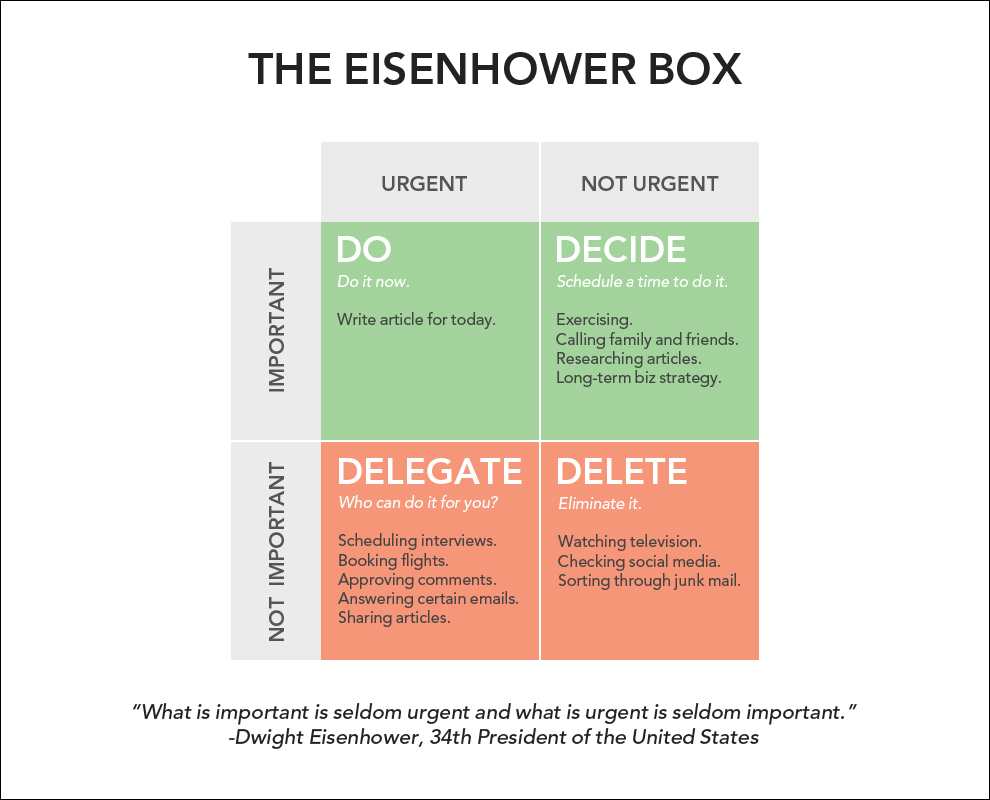
The Eisenhower Box: How to be More Productive:

Eisenhower’s strategy for taking action and organizing your tasks is simple. Using the decision matrix below, you will separate your actions based on four possibilities.

  1. Urgent and important (tasks you will do immediately).
  2. Important, but not urgent (tasks you will schedule to do later).
  3. Urgent, but not important (tasks you will delegate to someone else).
  4. Neither urgent nor important (tasks that you will eliminate).

The great thing about this matrix is that it can be used for broad productivity plans (“How should I spend my time each week?”) and for smaller, daily plans (“What should I do today?”).

Here is an example of what my Eisenhower Box looks like for today.

how to be more productive with the eisenhower box

I am attaching my 5th-semester timetable (time managing)

Page_0


Habits are Key to Success.

Habits are formed by the repetition of particular acts. They are strengthened by an increase in the number of repeated acts.

3.jpg


In our daily life, 40 – 45% of Daily Behaviour are Habits. That means half of everything you do every day is a habit. For Example, the time you get up it might be early in the morning is a habit, I have that habit. Doing exercising, meditation, and bathing are also habits.


What are Habits?

Habits are automated behavior that repeats over and over again in the same environment that run into our subconscious mind.

Every Habit starts with a psychological pattern called the habit loop.

3 r (2).jpg

They are 2 types of Habits:

  1. Good habits.
  2. Bad habits.

Hard working, writing, reading, regular exercise, meditation, etc. are examples of good habits. Alcoholism, drug addiction, lethargy, procrastination, telling lies, dishonesty, stealing, deceiving others, escapism, etc. are examples of bad habits.

We need to eradicate all the bad habits in order to improve our lifestyle. It also boosts confidence in yourself when you don’t have any bad habits. Once addicted to them, it is very difficult to get out of them but it doesn’t mean it is an impossibility one.

You don’t eliminate a bad habit, you replace it.

How to break bad habits?

  1. Choose a substitute for your bad habit.
  2. Cut out as many triggers as possible.
  3. Surround yourself with people who live the way you want to live.
  4. Visualize yourself succeeding.
  5. Do a review, when u have a bad habit relapse.

You can also visit tinyhabits.com where they will help you up with developing new habits

Studies say that it will at least take a minimum of 21 days to develop new habits. It might become a habit in 30 days or 3 months or might be a year. The only way to get to Day X(X is the day when your activity you were doing turns into a habit) is to start with Day 1. So forget about the number and focus on doing the work. If you focus on choosing the right small actions, building the right environment, and using the right small rewards, the habit you build will be stronger and develop faster.


Strengths and Weakness.

Strengths and weaknesses generally refer to a person’s character. Often a strength can be a weakness, and vice versa, a weakness can be a strength.

Improve your Strengths, you can achieve your goals. if you increase your Weakness you may or may not achieve your goals.

My Strengths are

  1. Hard working
  2. Remembering power
  3. Quick Learning
  4. Discipline.
  5. Patience.
  6. Dedication.

My Weakness is:

  1. Unable to Concentration more than 30 min.
  2. Time Management.
  3. Communication Skills have to improve.
  4. Writing skills.
  5. Stage Fear.


Goal Setting and Result Orientation.

Goal setting is definitely important as it gives a clear path of what we want to achieve, an achievement in either working or personal. It helps us to stay on track all the time without getting lost.

GOAL SEETINGS

They are 2 types of Goals:  Short-term goals and Long-term goals.

shortterm goal is something you want to do in the near future. The near future can mean today, this week, this month, or even this year. A shortterm goal is something you want to accomplish soon. Something that will take you a long time to accomplish is called a long-term goal.

Why Results-Oriented Goal Setting is Effective?

By focusing more on results than the processes, organizational objectives are achieved in a fast and effective manner, eliminating wastage of tasks and efforts. Sometimes, it so happens that processes are completed without achieving the end result desired. Precious time and efforts may go waste when such occasions crop up in organizations.


IKIGAI

ikigai of saikrishna


Ikigai (see diagram) comes from the words ‘iki’, meaning life and ‘gai’, meaning value or worth. It’s about feeling your work makes a difference to other peoples’ lives.

The diagram helps you to measure what you love, what you’re good at, what the world needs and what you can be paid for. The spot in the middle is known as Ikigai.

I know it is not as easy as it seems to be, even when I tried it, I could not finish it.

Johari Window


Johari window is a communication model that can be used to improve the understanding between the individuals, teams, group. It is based on self-disclosure & feedback. The Johari window can are be used to improve group relationship with others. There are two key ideas behind this

a) Individuals can build trust among themselves by disclosing information about themselves

b) With help of feedback, they can learn about themselves

There are few aspects of us which are known to us while few aspects which we are unknown likewise their are some aspects & characteristics of us that other know and few things which are unknown to others also which are as follows.

JOHARI-WINDOW-1

1.Open Self

It is called as public area this self-represent ideal situation where the person knows about himself & about others. Here openness and compatibility are a high  Mutual understanding between people is high. Here there is little or no scope for conflict. Open self-includes information such as occupation, physical appearance, personal information etc.

2. Hidden Self

It is also called as a private or secret area the person knows about himself but does not know about others. The person remains hidden from others due to fear that how other might react the person keeps true feelings and attitude secret and will not open to others there is potential for interpersonal conflict. Hidden self-contains information which one wishes to keep private such as dreams or ambition

3. Blind self

Here one might think that this poor leadership but other think that he has strong leadership skill. The feelings of incompatibility which is difficult for the individual to face directly but can be seen by others.

It is necessary to reduce the size of blind self by providing increased honest feedback from others about the person in this situation there is potential for interpersonal conflict.

4. Undiscovered Self

It is the explosive situation.the misunderstanding may lead to interpersonal conflict

Size of open self can be expanded vertically into blind self by actively listening to the feedback from the group member. The size of open self can be expanded horizontally into hidden self by self-disclosure of information to the group.

The larger the open self the more rewarding effective relationship. Open self can be considered a place where good communication happens. Established team members have large open area than new team members. New team members start with the smaller open area because of little knowledge about each other.

Feeling happy, after talking with Divakar Sir.

coffee talks

My classmate (Saishandilia) and I were sitting in the coffee shop and were a bit nervous as were meeting Divakar sir for the first time. We don’t know what he was going to ask, we really had no clue how his interaction is going to be with us. All I knew about him was when I went through his blog. The blog was very much interesting to read.

Sir asked me to tell about the happiest moment in my life, I said about I got a seat in IIT Madras is the Happiest Moment in my life.

Important things to be carried along from the meeting are

1)When you are introducing yourself, introduce by Who you are? Why you are? What you are? If you are able to answer all of these questions, your introduction is complete.

2)Never worry about future life. No one knows what is going to happen in the near coming future. Its just that if you put in efforts, probability increases.

3)The purpose of your life is to share knowledge. When you start sharing knowledge, you measure your life.

The meeting went very well. In fact, we never expected that I would be directly talking to a director of a company. The meeting was very much beneficial for both of us. Only, in an hour, we were able to gain a lot of knowledge. Divakar sir has also told us to record the happy moments that happen to us and this was the motivation behind to start this blog.